Date: 08/06/2022 – Distance: 5.4 mi – Elapsed Time: 6.0 hr – Ascent: 171 ft – Descent: 114 ft – Difficulty: Easy
Have you ever been to the Ohio State Fair? Did you go this year? Did you know they have an 8 acre State Park there, complete with an arboretum, prairie, and wetlands as well as educational exhibits? You may have missed it this year, but make sure you check out this area next year.
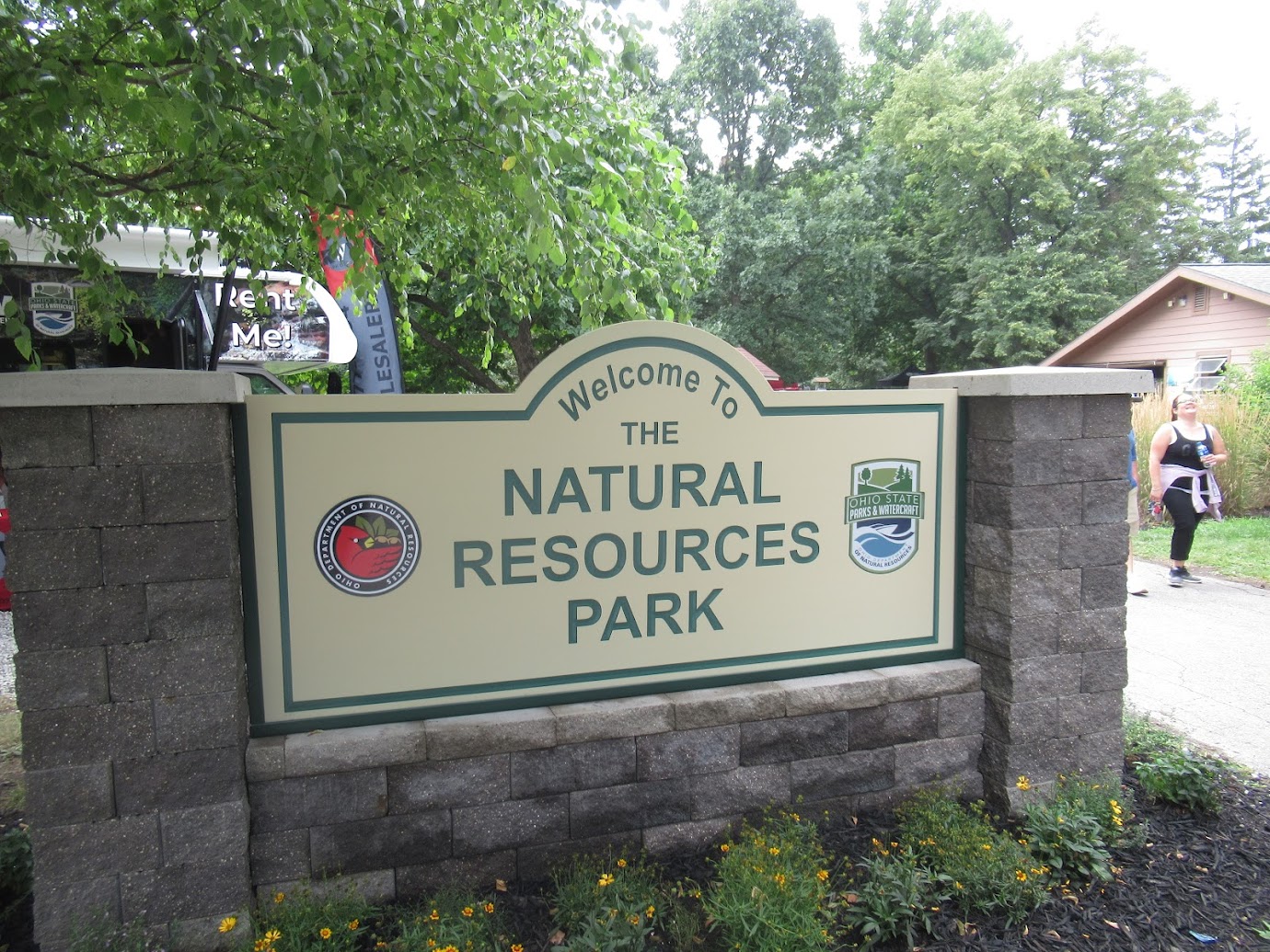
The Ohio State Fair takes place every year at the end of July and first week of August. It primarily is a place for showcasing the state’s agriculture including plants, animals, and practices. There are also lots of rides and lots of food options. The Ohio Department of Natural Resources also has a park here where it showcases many things from around the state as well and is called the Natural Resources Park.
The main drag has mostly food.I saw 89 year old Willie Nelson here the night before. He was amazing.The 8 acre Natural Resources Park is located on the southeast corner of the fairgrounds.Sign near the entrance.Map showing some of the main attractions.There is even a small Nature Center.They have a live turtle.Turkey.Short Eared Owl.The Buckeye Trail Association has a booth.A portion of the trail actually passes through here.This fire tower actually was moved here from Pike State Forest.Oil and Gas Management has an information booth.State Nature Preserves also has a booth.There is a prairie, and it’s quite a showcase.Some of the wildlife found in Ohio prairies. Controlled fire is used to maintain prairies.Purple Cone Flower.Blazing Star.Wild Bergemot. Royal Catchfly.Prairie plants have deep roots.Some prairies even can be found in wetlands.Many of Ohio’s prairies are gone.Even though it’s a pest, Poison Ivy is a native plant.Iron Weed.Rattlesnake Master has cool flowers.Prairie Dock can grow 8 feet tall.Gray Headed Cone Flower.Bison used to roam Ohio.Tick Trefoil.Wild Senna.Compass Plant I believe.Flowering Spurge.There is even a youth shooting range here.Wildlife Management booth.The trappers have a building where they educate…And showcase some of their tools.There is a long history of trapping in Ohio.Trapping helps maintain healthy populations.Some small traps.There is a youth fishing pond.A reconstructed wetland habitat.A small game bird showcase. These are Bobwhites or Quail.Because of habitat decline, quail are a fraction of their former numbers.Pheasants are beautiful.Pheasants were actually introduced from Asia in the 1800s.Female Wild Turkey.Turkeys were once hunted to extinction in Ohio but have been successfully repopulated.Male turkeys are quite different from the females.Looks like a Cardinal Flower.Another angle of the wetland. The ducks are fake.There is a butterfly showcase.Doors help keep them in a protected enclosure.Milkweed is a favored flower. This is a Common Milkweed seedpod.Swamp milkweed. Ohio has lots of butterflies.Monarch on Joe Pye Weed.Iron Weed is another favorite.Swallowtail on Iron Weed.Mating Monarchs. There are hundreds of butterflies in here.They cover the flowers.They are quite beautiful.Red Admiral.This park is also an arboretum with many large specimens like this Sycamore.Smokey was there educating everyone about fire safety.You could even try putting out a pretend fire.There is a nice native fish exhibit.With identification posters to help you learn the names.They even have some of the less frequent fish.Bluegill and Bass.Channel Catfish.The northern 2/3 of Ohio was once covered my mile thick glaciers which carved deep grooves in the bedrock on Lake Erie.There is a history exhibit showcasing some of Ohio’s people.The Civilization Conservation Corps was a depression era works project They helped build a lot of parks.Here they are carving stairs in Old Man’s Cave.Grandma Gatewood was a famous hiker from Ohio and Lucy Braun a famous botanist.There are historic sites all around the state. Try searching “historic place” on google maps.Great Council is Ohio’s most recent State Park.It’s going to be dedicated to Ohio’s rich Native American history.An early map of Ohio’s and neighboring states waterways.This is an old map of Ohio’s Native American trails.Many Native American artifacts can be found all around Ohio.Some more artifacts.H2Ohio helps protect the state’s water resources from pollution and invasive species.Sea Lamprey is a scary looking invasive species found in Ohio brought in by ship ballast water.They had a tank with a few of these scary creatures.Ohio also has vast mineral resources.Coal, Salt, and Limestone are common.Old mines require ongoing management.Many mines in Ohio are being returned to natural areas.Safety is a big part of management.There is a great geology exhibit.This cool map shows Ohio’s glacial and bedrock history.Many different events shaped the geology of Ohio.Most of the rocks near the surface are sedimentary. A self guided trail showcases the many rocks found around the state.Ohio’s Precambrian Period (4.5 billion – 451 million years ago) was mostly volcanic. These rocks are deep under the surface and the only samples we have are drill cores from deep or those transported here by glaciers from the north like this rock, commonly know as a glacial erratic. You can only find these in the northern half of the state.The Cambrian Era (541-485 million years ago) is also buried deep under the surface. During this time many animals formed and some of the earliest fossils can be found.The Ordovacian period (485-444 million years ago) are some of the earliest surface rocks found in Ohio. Ohio at this time was located 20 degrees south of the equator and was a shallow sea. Found exposed in the Caesar Creek State Park area, these rocks are limestone with lots of small fossils.This is a casting of a large fossil found in Ohio from the Ordovacian period called a Isotelus Trilobite.The Silurian period (444-419 million years ago) produced rich limestone deposits in Ohio which often dried up and created large salt deposits and dolomite (a Magnesium infused limestone). The salt is found deep under Lake Erie near Cleveland and the Dolomite can be found exposed in John Bryan and Paint Creek State Parks.Salt sample from deep underneath Lake Erie. These are some of the best salt deposits found anywhere.The Devonian period (419-359 million years ago) was a transitional period for Ohio comprised of seas teaming with life and corals. The rocks are limestone and dolomite in the lower/older layers with shale and sandstone in the upper/younger layers. The statehouse is built with this limestone and is rich with fossils. The best exposed example is along the Lake Erie shore.This is an excellent example of Devonian period fossilized coral known as Emmonsia or Giant Honeycomb Coral. This was found in Picaway County.Closer view of the coral fossil.The Dunkleosteus Terrelli is Ohio’s largest fish fossil from the Devonian period. It was an armor plated fish and was a top predator and its fossils were found in the shale.A life sized replica of the Dunkleosteus. I’ve also seen a larger replica at the Gladie Visitor Center in the Red River Gorge in Kentucky. It was twice this size and could easily eat a Great White Shark.Another Devonian period rock is Concretions. These formed in the shale layers and are from organic matter trapped in the mud. You can see these exposed in central Ohio at Highbanks and Shale Hollow Metro Parks.This graphic shows how the plants evolved over the periods.During the Mississipian period (359-323 million years ago), Ohio was near the equator. During this time the North American and African tectonic plates collided and formed the Appalachian Mountains. Sands from rivers east of the state washed in and eventually created the sandstone layers which can be seen in Hocking Hills and Mohican State Parks.Flint is one of Ohio’s gemstones composed primarily of quartz. It was highly sought after by Native Americans for making weapons due to its ability to be easily worked into sharp edges. The best deposit of flint is in Flint Ridge State Memorial.The Pennsylvanian period (323-299 million years ago) was characterized by vast equatorial swamps containing lots of vegetation and giant insects. All of the carbon was compressed into pockets of coal during this time.This is a nice sample of coal.The Permian period (299-252 million years ago), Ohio has moved north of the equator and had risen above sea level. Rocks from this era are sandstone and can be seen in Barkcamp and Forked Run State Parks.Ohio’s Permian sandstone was used to create high quality grindstones for sharpening tools and grinding grains.During the Permian period, an asteroid struck Ohio around the Serpent Mound in southern Ohio.During the Mezazoic and Tertiary period (252-2.6 million years ago) Ohio moved into its current latitude. This era was also the age of dinosaurs in Ohio.The Pleistocene era (2.6 million – 11,700 years ago) was also the Ice Age. Landforms across the northern 2/3rd of the state, where the ice was, are seen as deposits of gravel and large boulders known as erratics were deposited by ice, which moved in from Canada. You can see an esker (a bank of gravel left by an under ice river) at Siegenthaler-Kaestner Esker State Nature Preserve and kettle lakes (formed by large blocks of ice which broke away from receeding glaciers) at Stages Pond and Triangle Bog State Nature Preserves. Gowganda Tillite is one of the oldest glacial erratics in Ohio. It was created 2.6 billion years ago near the northern edge of Lake Huron by glaciers compacting sediment into stone. It was then later carried into Ohio by subsequent glaciers.On the Lake Erie Islands are some formations known as glacial grooves. These were created as mile thick ice laden with stones scraped across the limestone bedrock, carving striations in the rock. Kelley’s Island has one of the deepest of these found anywhere.These rock cores were taken from 1000s of feet below the surface in Ohio and give us an idea of the composition of earlier era layers.After seeing everything in the Natural Resources Park, I headed over to the livestock exhibits. These barns are huge.Hundreds of rabbits.Thousands of chickens.Some exotic species.Geese.Huge turkeys.He’s a handsome fella.Heading into the horticulture building.Gladiolus. Miniature Landscape.Cacti. Champion zucchini. I also saw the pigs. I couldn’t stay long from the smell, but this guy was impressive.For some reason the butter sculptures are a big deal. I don’t understand why, but this building was crowded.The veterinarian building was currently empty.They were having sheep awards in the coliseum. This sheep was getting groomed.This machine was grinding flour.That’s a big mower.Corn planter.







Leave a Reply